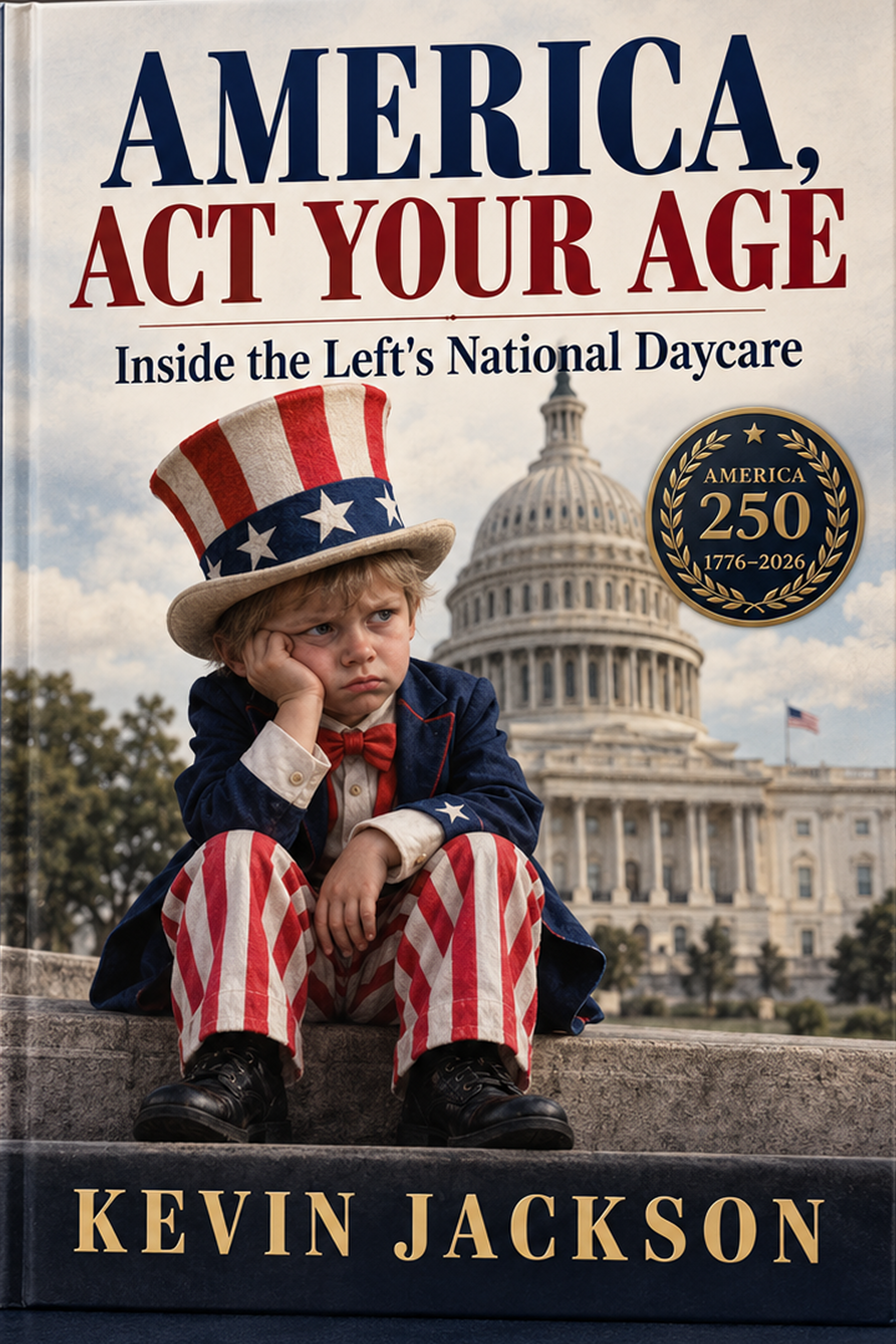
America, Act Your Age · Prologue
The Little Boy Who Didn’t Get a Vote
My mother died before I was five. At that time, my father was in San Quentin for armed robbery.
I mention these things because modern America has developed a fetish for origin stories. We treat childhood trauma the way old European families treated royal bloodlines. Produce the proper wound and suddenly people are expected to address you by title.
His Royal Highness, Duke of Abandonment.
Lady Unresolved Trauma of the House of TikTok.
Baron von Somebody-Owes-Me-Something.
By today’s standards, I was born into a franchise opportunity.
Dead mother. Imprisoned father. Poor Black child. I had the complete social-justice starter kit before kindergarten. If victimhood had existed then as the professional sport it is now, I could have gone pro before learning cursive.
But my grandparents ruined everything.
They raised my older brother and me with an outdated—and now possibly unconstitutional—idea: whatever happened to you, your life remained your responsibility.
They did not deny hardship. They simply refused to worship it.
Hardship entered their house like a muddy dog. They acknowledged it, dealt with it, and made sure it didn’t climb onto the furniture.
Nobody arranged the household around my feelings. My grandparents loved me far too much for that. They expected me to think, work, behave, and become something. They offered compassion without converting it into an alibi.
That distinction may have saved my life.
It certainly destroyed my chances of becoming a celebrated activist.
Imagine what I could have accomplished if somebody had explained that my circumstances exempted me from expectations. I might have earned six figures lecturing successful people about privilege. I could have written grant proposals explaining why punctuality is a colonial construct. Perhaps some university would have appointed me Dean of Things That Happened Before I Was Born.
Instead, my grandparents made me grow up.
They belonged to a generation that understood something we have nearly educated out of existence: children begin life helpless, but helplessness is not supposed to become their identity.
Childhood is dependency with an expiration date.
Or it used to be.
America has since discovered extended-release childhood. We found a way to keep people emotionally twelve, intellectually supervised, and financially attached to somebody else well into middle age. We manufacture adults who can operate every feature on a smartphone except the one that calls their father.
They know eleven words for emotional discomfort and none for changing a tire.
They can identify misinformation at fifty yards, provided an approved institution has labeled it for them.
They demand complete individual autonomy and then wait for the group chat to tell them what they believe.
This is the great contradiction of modern America: everybody wants to be recognized as a unique individual while holding the same opinions, repeating the same slogans, wearing the same moral costume, and attacking the same stranger on cue.
Our new rebels travel in herds.
They believe themselves to be free thinkers, yet they arrive preassembled.
Ask one what he believes and he will recite what ten thousand people posted that morning.
Ask why he believes it and watch his eyes perform the spinning-wheel symbol.
The information is buffering.
The education system produced this citizen deliberately—or at minimum discovered the design flaw and put it into mass production.
We were once told that education taught people how to think. Today, too much of it teaches people how to recognize the answer preferred by the authority administering the test.
Students learn quickly that curiosity may be celebrated in the brochure, but compliance gets the grade.
The diploma certifies not merely that the student completed the curriculum. It often certifies that the curriculum completed the student.
Then graduation arrives.
The university releases its creation into the wild, where corporate media assumes custody.
The graduate leaves campus but never escapes the classroom. The professor becomes the anchor. The syllabus becomes the approved narrative. The pop quiz arrives every morning: Who are we angry at today?
Which word has changed meaning?
What must respectable people pretend not to notice?
Your answers will be graded publicly.
Participation is mandatory.
Consider the modern protester. He stands in the street chanting that Donald Trump is a fascist. Ask him to define fascism, and suddenly you have presented a dolphin with a mortgage application.
There is effort. There are sounds. Neither of you is leaving with a loan.
He knows fascism is bad. He knows Trump is bad. Therefore, Trump must be fascism. That is not a political philosophy. It is refrigerator-magnet algebra.
Bad plus bad equals Hitler.
The protester may also announce that capitalism has failed while recording himself on an iPhone, uploading the video through a multibillion-dollar technology platform, and checking whether the algorithm has monetized his denunciation of profit.
He opposes capitalism in much the same way people on vacation oppose room service.
Not tonight, thank you. But leave the menu.
The contradiction does not bother him because he was not trained to reconcile contradictions. He was trained to recognize teams. Facts are evaluated less by whether they are true than by whether they help the correct people.
That is how a person can condemn greed while shrugging at organized theft from taxpayers.
He does not first ask, “Was money stolen?” He checks the identities of the accused and the politics of whoever discovered it.
If the cast is inconvenient, curiosity becomes racism.
Theft acquires cultural sensitivity.
The treasury gets robbed, and half the country demands an investigation of the security camera.
This book is about that person.
But it is also about the institutions that made him, the men who failed to challenge him, the women encouraged to imitate him, the politicians who exploit him, and the media that keep him frightened enough to remain obedient.
More uncomfortably, this book is about the occasions when that person is us.
Because permanent adolescence is not confined to one generation or political party. It appears wherever adults demand freedom without consequence, authority without competence, money without production, sex without responsibility, children without sacrifice, opinions without knowledge, and government without limits.
Political ideology did not invent human weakness. It learned to organize it.
Leftism’s particular genius was recognizing that an adult who governs himself has less need to be governed by others.
Self-government is dangerous to people who wish to manage society. A man with discipline is difficult to frighten. A woman with confidence is difficult to flatter. A family that protects its own is difficult to replace. A citizen who can think is difficult to stampede.
So the culture began separating freedom from responsibility.
It told men that strength was suspicious, women that femininity was submission, children that discomfort was damage, minorities that achievement was betrayal, and white people that ancestry was evidence.
Everybody received a grievance.
Grievances are cheaper than opportunities and much easier to distribute.
The results surround us: men frightened of manhood, women taught to resent womanhood, children negotiating with parents, parents negotiating with children, universities afraid of students, employers afraid of employees, and a government that now resembles an exhausted mother attempting to satisfy four million toddlers in a grocery-store checkout line.
Everyone is screaming.
Everyone wants something.
And somebody has opened the candy before paying.
I do not pine for a past in which every man was noble, every woman was honored, every family was intact, or every American received justice. That country never existed.
But America did possess a clearer destination.
Adulthood was respected. Competence carried authority. Courage mattered. Men and women were permitted to need each other without treating dependence as degradation. Freedom was understood not as deliverance from responsibility but as the opportunity to assume it.
The Founders constructed a republic that required grown-ups.
Not perfect people. Not scholars. Not aristocrats. Grown-ups.
People capable of hearing an opinion without requiring medical attention.
People who understood that losing an argument did not erase their existence.
People who knew that a right imposed a corresponding duty of self-restraint.
People who could govern themselves before volunteering to govern everybody else.
That America is not dead. It is buried beneath several decades of therapeutic language, institutional cowardice, political manipulation, and educational malpractice.
But it remains there.
I know because I have met the people keeping it alive.
They run businesses. Raise children. Patrol streets. Teach real subjects. Repair machinery. Care for aging parents. Serve in the military. Coach teams nobody televises. Keep promises nobody applauds. They do the necessary work while professional victims hold press conferences.
They are not always eloquent.
Responsibility rarely hires a publicist.
This book is for them—and for those ready to join them.
It is a tribute to masculine men without being an indictment of strong women. It is a defense of feminine women without prescribing one life for every woman. It is an argument for the family, an examination of the machinery that weakened it, and an accusation against the institutions that converted American citizens into emotional dependents.
Most of all, it is a coming-of-age story about a country old enough to know better.
My childhood was not fair.
Neither is yours.
Now what?
That question separates biography from destiny. It divides the person who suffered from the person who intends to make suffering his occupation. It is the question my grandparents taught me to answer before America began teaching people to avoid it.
You did not choose every wound.
You do choose whether it becomes your personality.
You did not create every obstacle.
You remain responsible for the climb.
Nobody owes you a painless life, universal applause, protection from foolish decisions, or agreement disguised as respect.
You are free.
That means the consequences belong to you.
Welcome to adulthood.
Try not to burn it down before you learn how it works.